Efficient patient-initiated follow-up after orthopaedic injections
These articles reflect our opinions and thoughts on the subjects covered, not purely factual statements. We encourage readers to consult multiple sources and their own medical professionals.
If you run an MSK clinic and still book every injection patient back at six to eight weeks, this is for you. A Royal Surrey foot and ankle series found that 91% of those routine follow-ups were unnecessary. Most patients either needed no review at all, or needed one much later - on their terms, when pain came back.
The paper is by Ka Siu Fan, Iqraa Haq, Ali Taha, Andrew Carne, Chintu Gademsetty, and Matthew Solan (my dad). I did not write the study. I build the software that turns the diary idea into something clinics can run without photocopying VAS sheets.
Plain English
- Patient-initiated follow-up (PIFU)
- The patient asks for a review when they need one, instead of sitting in a fixed 6-8 week slot that most people do not need.
- Pain diary
- A simple record of pain over time - usually a visual analogue scale - so you can see when the injection helped and when it wore off.
- What the 91% means
- In this series, only about 9% needed a follow-up inside the usual 6-8 week window. The rest did not need that appointment at that time.
What the Royal Surrey study found
The team followed 104 patients after foot and ankle injections over about a year. The injections mixed local anaesthetic for immediate relief with corticosteroid for a longer anti-inflammatory effect. Duration of benefit varied wildly - which is exactly why a calendar slot at week seven is a blunt instrument.
Usual practice (survey context in the paper)
- Most clinicians still book routine 6-8 week reviews
- Those slots cost roughly £100-200 each in the paper’s framing
- Pain relief length is unpredictable - so timing is often wrong
This series
- Only ~9% needed follow-up inside 6-8 weeks
- Median time to requested follow-up: 117 days
- 43% never requested a follow-up
- 57% eventually did, when they needed it
- Estimated £9,500-£19,000 saved per 100 patients from avoided early appointments
Hot take: most injection follow-ups in pathways like this are not “reviews”. They are insurance policies against not knowing how the patient is doing. A diary removes the need for the insurance slot. You keep the door open. You stop filling it by default.
Why the fixed 6-8 week slot fails
Steroid and local anaesthetic do not wear off on a spreadsheet. Some patients are comfortable at week six and flare at month four. Others never settle and needed you earlier. A blanket recall treats those people the same, burns clinic capacity, and still misses the ones who actually need help later.
Cost of inaction is boring and expensive. You keep paying for slots that do not change management, while the waiting list for new patients grows. The paper’s savings band (£9,500-£19,000 per 100 patients) is the polite version of that.
The study used paper diaries
Important honesty: the Royal Surrey work used a paper pain diary - a visual analogue scale patients filled in over time. That is what proved PIFU can work here. It did not prove that an app is magic.
Paper still has the problems you would expect. Sheets get lost. Entries get filled in retrospectively on the bus to clinic. Quiet patients disappear. Clinicians cannot see a trend until the folder lands on the desk.
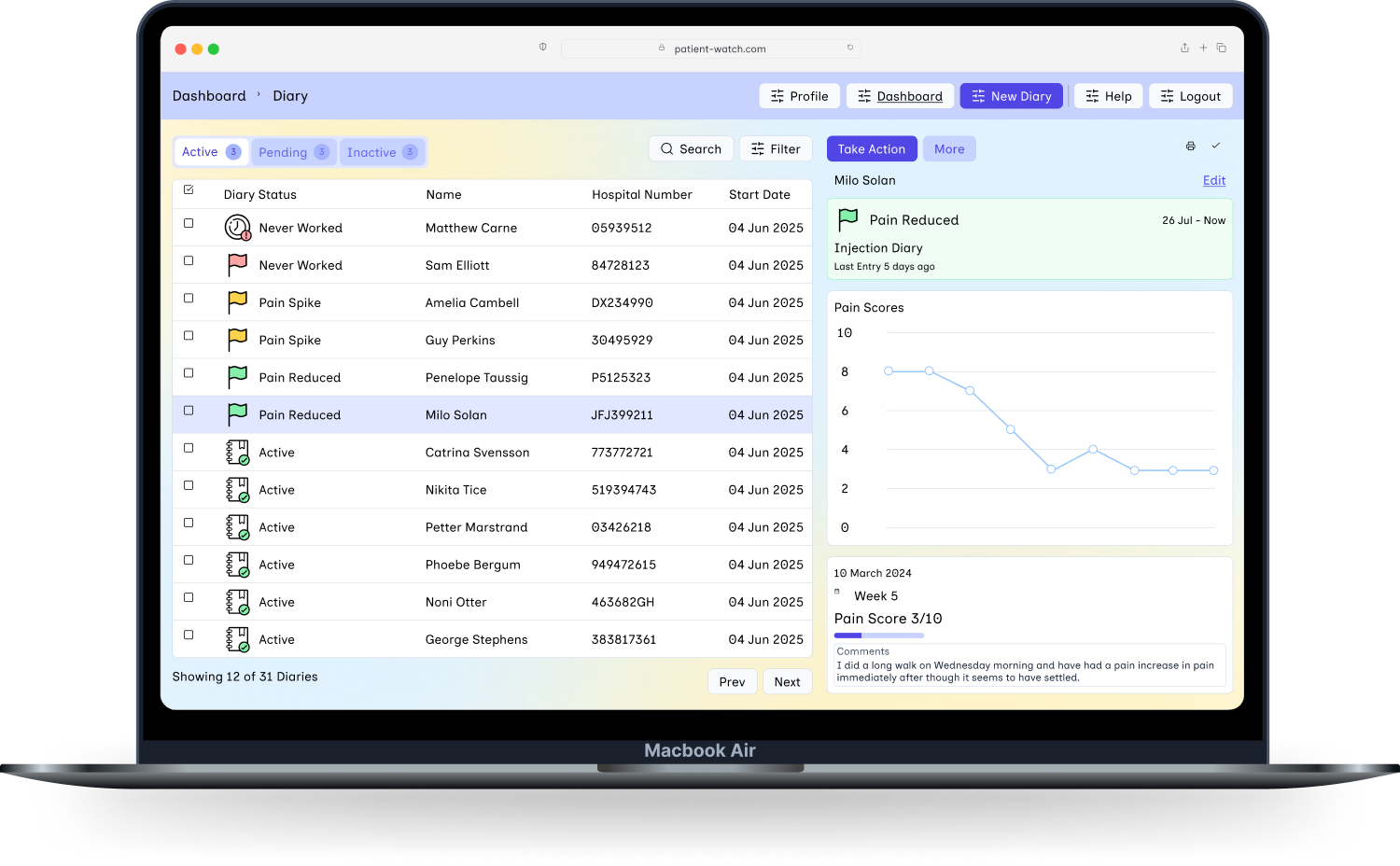
What the diary gave the team, paper or otherwise, was the useful bit: a picture of when pain dropped and when it returned, so the next decision (repeat injection, different site, surgery talk) was based on a pattern rather than a single clinic snapshot.
What digital changes - and what we sell
Digital does not invent PIFU. It makes the diary less fragile. That is the part Patient Watch is built for: questionnaires and simple scores on a schedule, with reminders that get people to actually reply.
How we run injection follow-up
- Scheduled scores, not photocopies. Patients get the diary prompts on their phone. Timestamps beat “I filled it in this morning from memory”.
- Reminders that chase the quiet ones. Our directional figure is about 85% of questionnaires coming back, against a ~12% figure often cited as a paper / national baseline. Directional, not a contract SLA.
- Clinician view of the trend. You see when pain rose again without waiting for a wasted face-to-face slot to find out nothing has changed.
- PIFU still needs a door. Software does not replace the agreement that patients can request review. It just stops you booking the empty ones.
What the avoided appointments are worth
Using the paper’s appointment cost band, the arithmetic is straightforward. Book 100 routine reviews and you are looking at about £10,000-£20,000. If only ~9 of those patients needed you in that window, you have paid for a lot of empty chairs.
| Approach | Follow-ups in the early window | Cost framing per 100 patients |
|---|---|---|
| Standard 6-8 week recall | 100 appointments | £10,000-£20,000 |
| PIFU guided by diary need | ~9 appointments in that window | £900-£1,800 |
| Difference the paper highlights | ~91 avoided early appointments | ~£9,100-£18,200 |
Framing from Fan et al. Digital tooling does not invent a new saving number; it is how you run the pathway without paper friction.
Royal Surrey’s wider injection volume (the paper discusses the service doing on the order of thousands of injections a year) is why this is not a toy finding. Even if you only apply it to one pathway, empty follow-up slots add up.
Beyond foot and ankle
The evidence here is foot and ankle injections. I would not pretend a knee HA series or a spinal injection clinic has already been measured the same way in this paper. The logic still travels: any pathway where benefit duration varies and routine recall is mostly reassurance is a candidate for diary-backed PIFU.
In our own work that usually means MSK injections and procedures where you care about pain and function over weeks to months - steroid, HA, PRP, shockwave, and post-op check-ins that do not all need a chair. Further research is needed before anyone quotes “91%” outside this setting.
What still bites
PIFU fails when patients do not know they are allowed to come back, when the diary is too annoying to fill in, or when nobody notices the people who go quiet. Vulnerable patients need a safety net - not a shrug that “they’ll request if they need to”.
| Risk | What we do about it |
|---|---|
| Patients forget or stop answering | Reminders on a schedule. Quiet patients stay visible instead of vanishing into a paper pile. |
| Low digital confidence | Keep the score simple. Someone helping at home can complete it. Not every pathway needs a 40-item PROM on day one. |
| Clinic culture still books everyone back | Software will not fix a pathway you have not rewritten. The diary only helps once the default recall stops. |
| Retrospective diaries | Timestamped digital entries make “I filled three weeks at once” harder to hide. |
Our take
Most routine injection follow-ups in pathways like this are wasted clinic slots wearing a clinical costume. Diary-backed PIFU is how you keep safety without paying for empty chairs. The Royal Surrey paper proved it on paper. Digital is how you run it without losing the sheets.
Want this running on your injection list?
We can set up a simple pain / PROM schedule with reminders and a clinician view of who is settling versus who needs the door opened.
FAQ
Is the 91% figure universal?
No. It is from this Royal Surrey foot and ankle injection series. Treat it as strong evidence for that pathway, not a universal MSK constant.
Did the study use Patient Watch?
No. It used paper diaries. Patient Watch is how we run the same idea digitally for clinics that want reminders and a live view.
Is PIFU safe for everyone?
Not as a dump-and-hope. You still need clear instructions, a way to request review, and eyes on people who stop responding. High-risk pathways may still need planned contact.
Is a pain VAS enough, or do I need full PROMs?
For deciding whether someone needs the early slot back, a simple diary is often enough. Full PROMs still matter for research, registries, and comparing treatments - different job.
Sources
- Fan, K.S., Haq, I., Taha, A. et al. (2025). Efficient patient-initiated follow-up after orthopaedic injections. European Journal of Orthopaedic Surgery & Traumatology, 35, 77. https://doi.org/10.1007/s00590-025-04193-9

Guy built Patient Watch at Imperial College London for his father, an orthopaedic surgeon. Today, NHS and private clinics use Patient Watch to automate questionnaire schedules, track patient recovery after injections and surgery, and collect real-world clinical evidence.
Related articles
3 real benefits of remote patient monitoring in clinical practice
Where remote patient monitoring actually helps: replacing wasted appointments, capturing recovery trends, and expanding clinical capacity.
Digital health tracking: what actually works in clinical practice
A practical guide for clinicians introducing digital patient tracking and outcome measures without adding administrative chaos.
Automated patient management: scheduled follow-up without the admin burden
How scheduled reminders, automated questionnaire delivery, and triage dashboards streamline routine musculoskeletal follow-up.